GameToolForgeOxygen Not Included
Guide · U59 build

SPOM Guide: Build the Oxygen Loop Once

A Self-Powered Oxygen Module is three things in one box: water in, oxygen out, hydrogen burned for power. The ratios are simple; the failures are almost always placement or pressure.

No save uploadFree, in the browser
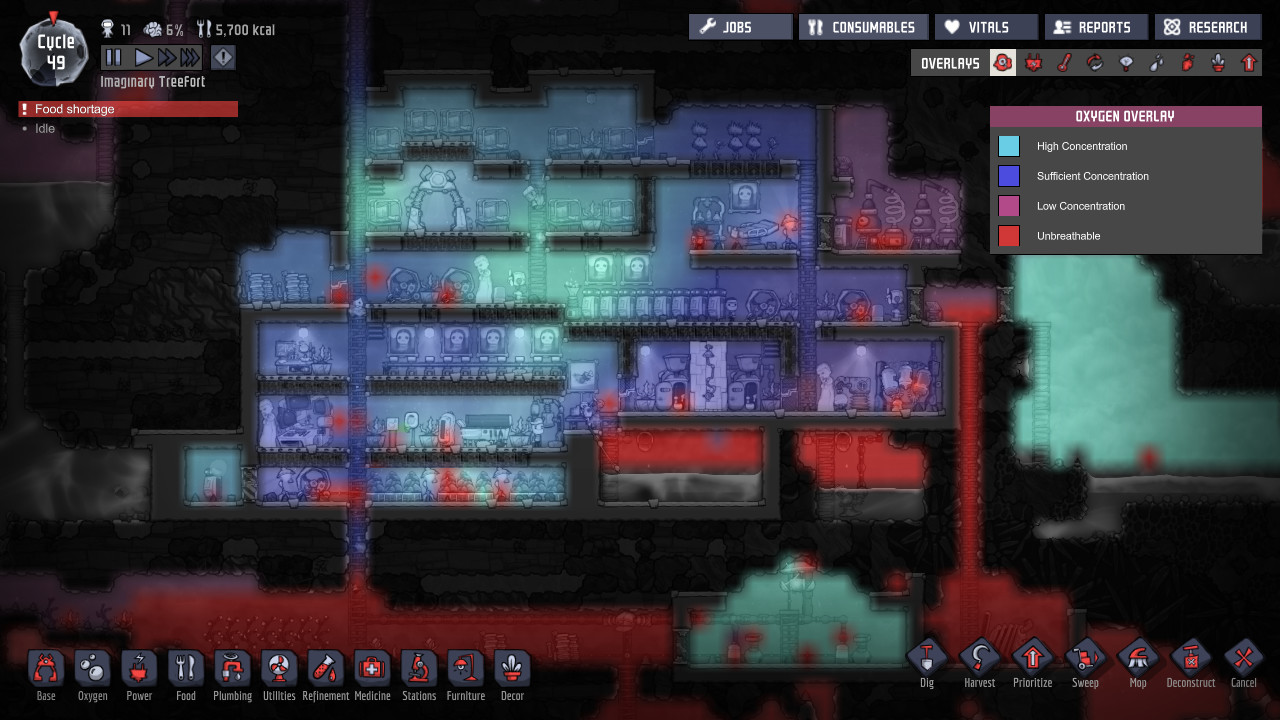
Oxygen overlay of a colony
01

The only ratio you need

An Electrolyzer takes 1 kg/s water and outputs 888 g/s oxygen and 112 g/s hydrogen. A Duplicant breathes 100 g/s, so one electrolyzer covers 8.88 Duplicants. For eight Duplicants, that is one machine with 88 g/s spare.

The pumps are sized from the output, not from the Duplicant count. Two oxygen pumps move 1,000 g/s, enough for 888 g/s. One hydrogen pump clears 112 g/s. That is three pumps, 720 W, plus the electrolyzer’s 120 W.

HYDROGEN LAYEROXYGEN LAYERElectrolyzer1 kg/s waterO₂ pumpO₂ pumpH₂ pumpHydrogenGenerator800 W3 pumps + electrolyzer840 W draw800 W back
One electrolyzer, two oxygen pumps and one hydrogen pump. The hydrogen pump sits at the ceiling; the oxygen vents sit low.
02

Placement beats filtering

Hydrogen is the lightest gas in the room, so it collects at the ceiling. The hydrogen pump belongs in the top row. The oxygen pumps belong lower, where the oxygen actually is. If the hydrogen pump is in the middle, it pulls a mix and the filter has to clean up a placement mistake.

A gas filter is a backup, not a design. It costs 120 W and a filter element, and it hides the symptom without fixing the separation. Build the room so the gases separate by height first.

  • Hydrogen pump at the ceiling.
  • Oxygen pumps one or two tiles lower.
  • Vents low and spread across the room.
  • A pressure sensor or a high-pressure vent so the room does not stall at 1.8 kg.
Size your SPOMEnter the Duplicant count and the water source.
03

Power, heat and the 40 W gap

The hydrogen generator makes 800 W from 100 g/s hydrogen. The electrolyzer and three pumps draw 840 W. The loop is 40 W short, not self-powered. A filter, a light or a second pump makes the gap bigger.

The oxygen leaves at 70 °C and the electrolyzer’s default overheat temperature is 75 °C. A sealed, uncooled room slowly cooks the machine. Use gold amalgam for a little headroom, but plan a cooling loop if the SPOM is inside the insulated base.

The SPOM is a three-pump building

The standard SPOM uses one Electrolyzer, two oxygen pumps and one hydrogen pump. The electrolyzer makes 888 g/s oxygen and 112 g/s hydrogen; the two oxygen pumps move 1,000 g/s against the 888 g/s output, and the hydrogen pump clears the 112 g/s at the ceiling.

The loop draws 840 W before the hydrogen generator returns 800 W, so it is 40 W short before lights or a filter. The hydrogen generator is not a free bonus; it is part of the power budget. The SPOM also needs 600 kg of water per cycle and a room that can take the electrolyzer’s heat.

  • 888 g/s oxygen
  • 112 g/s hydrogen
  • 3 pumps
  • 840 W − 800 W = 40 W short
Questions

Common questions

What does SPOM stand for?

Self-Powered Oxygen Module. It uses the hydrogen from an Electrolyzer to run a Hydrogen Generator, which covers most or all of the module’s power.

How many pumps does a SPOM need?

Three for the standard eight-Duplicant build: two oxygen pumps and one hydrogen pump. The oxygen pumps move 1,000 g/s against 888 g/s of output.

Does a SPOM need a gas filter?

Not if the pumps are placed correctly. A filter is a backup; it costs 120 W and can mask a placement problem. Keep the hydrogen pump at the ceiling and the oxygen pumps lower.

Why is my SPOM not self-powered?

The electrolyzer and three pumps draw 840 W; the hydrogen generator makes 800 W. It is a 40 W deficit, not a self-powered loop. Add a coal generator or accept the small draw.