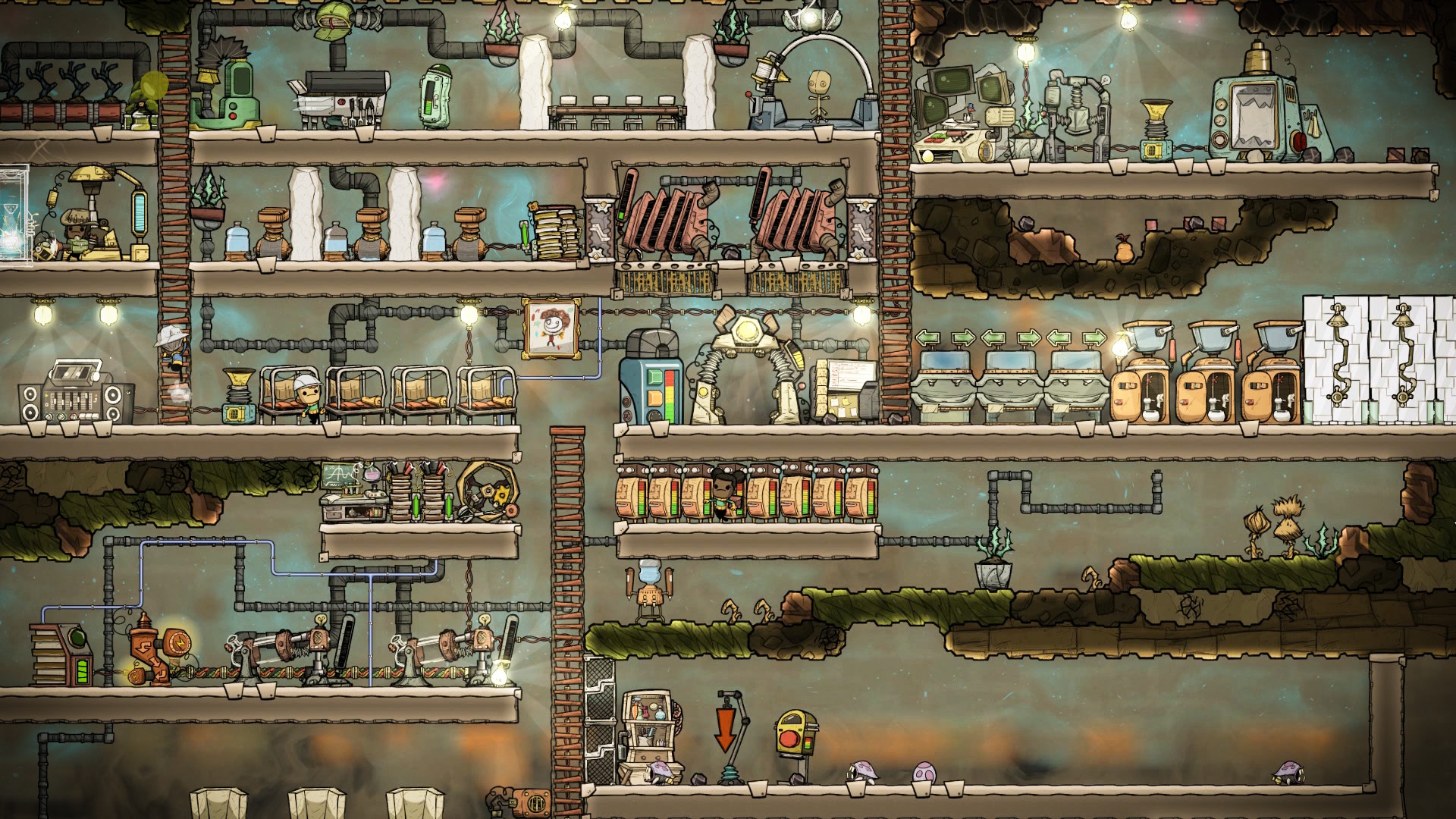
A normal gas vent stops at 2 kg per cell; a high-pressure vent stops at 20 kg. A full reservoir or a vent in a sealed room backs up the whole line.
Add a vent, a storage or a larger room. A pipe that loops with no consumer also stops once every segment is full.
03
Bridges and filters
A bridge has an input and an output; the arrow points from input to output. A reversed bridge pushes the packet back. A filter set to the wrong element sends the gas to the waste line and can block the input.
Check the bridge direction and the filter element before replacing the pump.
The three numbers behind a gas line
A gas pump moves 500 g/s and a gas pipe carries 1 kg/s. That is why two pumps can share one pipe but a third cannot: the pipe is already at its limit. A normal gas vent stops at 2 kg per cell, and a high-pressure vent stops at 20 kg. When the vent is full, the pipe backs up from the far end toward the pump.
An empty pipe and a blocked pipe look similar in the overlay but have different causes. An empty line has no packet at the pump: check power, the gas cell and the pump intake. A full line has packets that cannot move: check the vent, the reservoir, a reversed bridge or a filter set to the wrong element. Fix the first full link downstream, not the pump.
Pump: 500 g/s
Gas pipe: 1 kg/s
Normal vent: 2 kg/cell
High-pressure vent: 20 kg/cell
Questions
Common questions
Why is my gas pipe empty?
The pump may be in a vacuum, unpowered, or the pipe may be disconnected at a joint.
Why is the gas vent blocked?
A normal gas vent stops at 2 kg per cell; a high-pressure vent stops at 20 kg. Add a vent or reduce the input.
Why is gas not moving through a bridge?
The arrow must point from the input to the output. A reversed bridge pushes the packet back into the line.
Why does the pipe loop and stop?
A loop with no consumer has nowhere for the packet to go once every segment is full. Add a vent, a reservoir or a real destination.