How the book expects you to think
Return of the Obra Dinn Hints – Solve Every Fate
The game never asks you to guess. It asks you to notice: a name in a line of dialogue, a job on the manifest, a face in the sketch, a body that is not where it should be. Each clue type is explained in plain language, with the moment the book lets you use it.
Every page can be solved from something in the game: a line, a room, a job, a face, a number or the people left over. The hard part is knowing which kind of clue the page is waiting for. Start with the type of clue you actually have.
Two separate questions
Who is this, and what happened to them?
Identity and fate are entered on the same page, but they are solved from different evidence. You can name someone before you know how they died, and you can know how someone died before you can name them.
Naming someone
You need enough information for their face to unblur. The book applies its own rule: a specific memory or pair of memories must be visited before the page becomes editable. The manifest lists that rule for every person.
Once the face is clear, match the job, origin, accent, relationships and the artist’s sketch. Elimination is a legitimate and intended method for the hard pages.
Recording a fate
A fate is a cause plus a killer when there is one. Pick from the book’s own lists; the wording matters. Thirty-four people accept more than one wording, so an entry that looks wrong may still be accepted.
Disappearance is not the same as death. Thirteen people have no body, and four of them left the ship alive. The disappearance page is part of the chapter and still needs a fate.
What clue do you have?
Pick the clue type, see who it can point to
The book groups its clues into these types. Choose a type and the manifest narrows to the people whose page can be solved with it. The counts are how many people list that clue.
A name 19 people
Someone says the name out loud, the artist writes it beside a face, or it is engraved on an object the person carries. Seventeen people have a name clue in dialogue alone.
What to do: Read the transcript on the memory page, not just the scene.


The mechanics
How the book checks an answer
These rules decide when a page seals, why some answers never lock, and why a correct answer can sit in the book without being typeset.
1. A correct pair waits
A page counts when the name is right and the fate is one the book accepts. A right name with a wrong fate does not count. A right fate with a blurred name does not count.
2. Three at a time
Correct pairs accumulate. When three are ready, the book typesets all three, plays the seal animation and locks those pages. Wrong guesses stay editable and never block the group.
3. Pairs at the end of a section
When two or four fates are left unsolved in the current section of the book, the book checks in pairs instead of threes. This is why the last pages can seal two at a time — including the two fates in Chapter VIII.
4. Sealed pages cannot be changed
Once a correct page is typeset it is final for that save. There is no penalty for trying a wrong answer, but there is no undo on a sealed one either. The profile menu can rewind to the ship, which resets Chapter VIII only.
The hardest pages
Thirteen people have no body
They disappeared during three chapters. Their pages are still fates, and four of them were alive when they left the ship. Use the people around them and the chapter where they vanish.
| Person | Job | Chapter | What the game accepts |
|---|---|---|---|
| Charles Miner | Bosun's Mate | VII. The Doom | Show fateTorn Apart by a terrible beast / Crushed/Beast / Drowned by a terrible beast / Fell/Overboard / Eaten by a terrible beast |
| Henry Evans | Surgeon | IX. Escape | Show fateAlive/Africa |
| Duncan McKay | Purser | VII. The Doom | Show fateDrowned by a terrible beast / Fell/Overboard / Eaten by a terrible beast |
| Finley Dalton | Helmsman | VII. The Doom | Show fateTorn Apart by a terrible beast / Crushed/Beast / Drowned by a terrible beast / Fell/Overboard / Eaten by a terrible beast |
| Emily Jackson | Passenger | IX. Escape | Show fateAlive/Africa |
| Miss Jane Bird | Passenger | IX. Escape | Show fateAlive/Africa |
| Davey James | 4th Mate's Steward | IX. Escape | Show fateAlive/Africa |
| Omid Gul | Topman | VII. The Doom | Show fateFell/Overboard / Drowned by a terrible beast |
| Wei Lee | Topman | VII. The Doom | Show fateTorn Apart by a terrible beast / Crushed/Beast / Drowned by a terrible beast / Fell/Overboard / Eaten by a terrible beast |
| Alarcus Nikishin | Seaman | IV. The Calling | Show fateDrowned by a terrible beast / Strangled by a terrible beast / Clawed / Fell/Overboard |
| Aleksei Toporov | Seaman | IV. The Calling | Show fateDrowned by a terrible beast / Strangled by a terrible beast / Clawed / Fell/Overboard |
| Nathan Peters | Seaman | VII. The Doom | Show fateDrowned by a terrible beast / Fell/Overboard / Eaten by a terrible beast |
| Alexander Booth | Seaman | VII. The Doom | Show fateDrowned by a terrible beast / Fell/Overboard / Eaten by a terrible beast |
If the book feels impossible
Start with the eighteen easy pages
The book rates every identity easy, medium or hard. The easy ones give you names, rooms and relationships that unlock the harder pages by elimination.
Robert Witterel
Captain · England

William Hoscut
First Mate · Scotland
Edward Nichols
Second Mate · England
Christian Wolff
Gunner · Austria
Edward Spratt
Artist · England
Abigail Hoscut Witterel
Passenger · Scotland
Nunzio Pasqua
Passenger · Italy
Bun-Lan Lim
Passenger · Formosa
It-Beng Sia
Passenger · Formosa
The book rates each page Easy, Medium or Hard. It is an effort hint, not a guarantee: a hard page can become easy once the people around it are named.
Common traps
Eight mistakes that cost a run
These are the places where the book and the ship stop matching what players expect.
Not everyone is crew
The stowaway, the cow, two mermaids and the monkey die on screen but are not among the 60. Their deaths do not count as fates and do not unlock chapter achievements.
Disappeared does not mean dead
Thirteen people disappear; four of them are alive in Africa. Record the correct outcome, not “died at sea”.
Story order is not discovery order
The first memory is The End, Part 1. Chapter I is in the hold. Chapter VIII is not on the ship. The book’s page numbers do not tell you where to walk.
Two names are very close
The closest traps are the two Witterels — Robert and Abigail Hoscut Witterel — and the two Peters, Nathan and Samuel. Abigail also shares the name Hoscut with the first mate. Check the job and the portrait before you seal a page.
The boat is not a chapter exit
Leaving is the point of no return. The boat appears after all ship memories are visited; Chapter VIII needs all 58 ship fates correct before you take it.
A sealed page is final
Wrong guesses do not seal, but correct ones do. If you are experimenting, experiment with wrong names, not with a name you may want to change later.
Blur is not a bug
A face stays blurred until the book has the memory it needs. For most people the requirement is a specific scene; the manifest page tells you which one.
“Accepted” is literal
The book checks wording. “Shot with a gun” and “shot” are not interchangeable unless both are listed. The fate page shows every accepted wording for each person.
The clue vocabulary
Every clue type the game uses
These are the categories behind the book’s deduction ratings, explained in plain language.
A name spoken out loud
The simplest clue. A crew member addresses someone by name or mentions them in a line. The book records the line on the memory page, so you can read it again without replaying the scene.
A job and a room
The deck plan labels cabins by officer: first mate, third mate, bosun, midshipmen, stewards. If a person is standing in one of those cabins and no one else can be there, the room is the clue.
An accent or a language
Origins narrow the list. A Formosan passenger speaks Taiwanese; a Russian seaman speaks Russian; a Welsh steward sounds different from an English one. Match the language you hear to the manifest.
The artist’s sketch
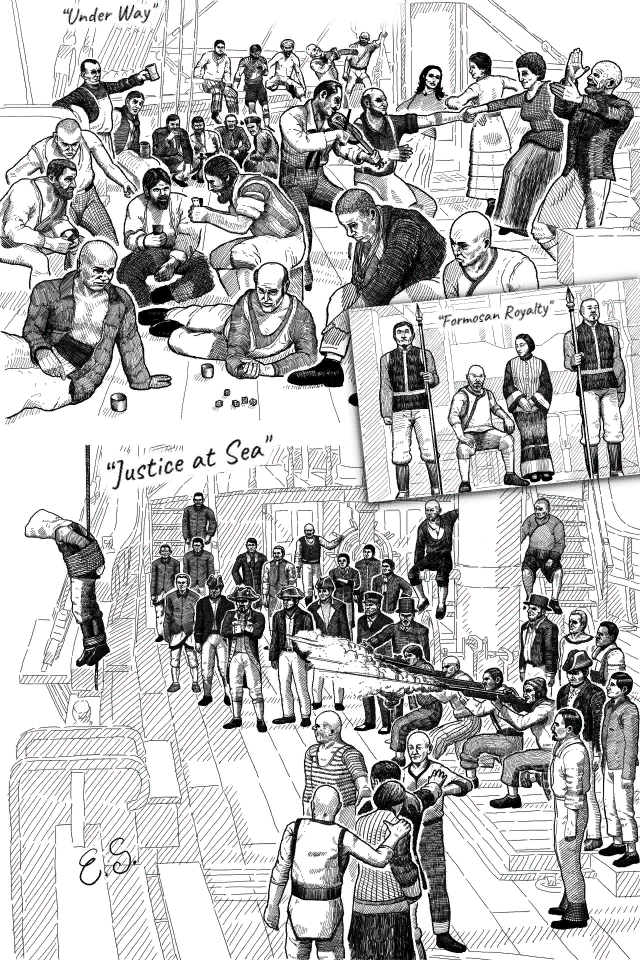
The sketch pages group people by scene — Under Way, Formosan Royalty, Justice at Sea. A face that is hard to place in a memory is often labelled or grouped in the sketch.
A relationship
“Your brother.” “My friend.” “Captain.” Relationships eliminate names: if two people are brothers or married, the manifest and the sketch usually show who is who.
A manifest number
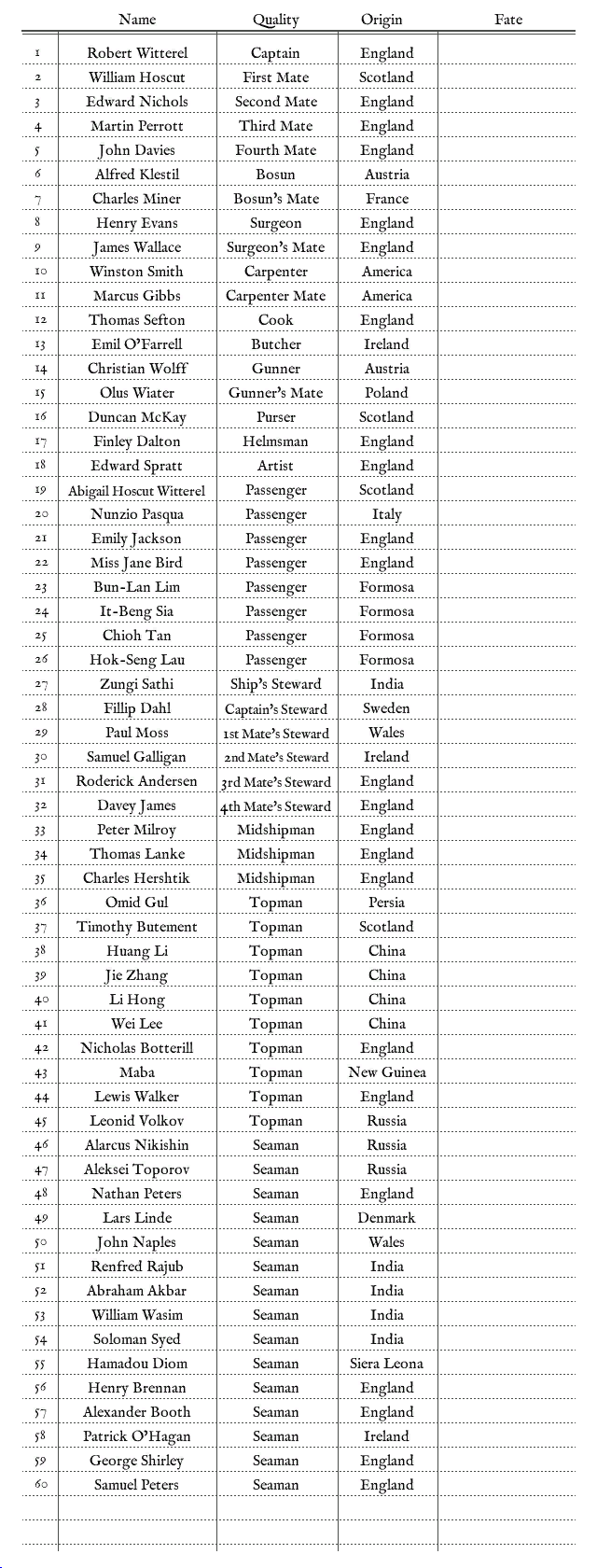
The manifest numbers people 1 to 60. Hats, crates and markings sometimes carry a number, and the book’s pages are ordered the same way.
Elimination
When every other person with that job, origin or cabin is already named, the one left is the answer. Elimination is intended for the hard pages, where clues are partial and several people share a role.
The ship’s vocabulary
What the jobs and decks mean
The book uses the ship’s own ranks and places. If a page says “bosun” or “orlop”, this is what the game means.
Captain
Head officer in command of the ship. Directs the other officers and answers for the success and safety of the voyage.
Mate
Officer or tradesman who supports a superior. General mates help run the ship; a tradesman’s mate serves that tradesman.
Bosun
Foreman in charge of general crew operations and the equipment needed to sail the ship.
Gunner
Military officer in charge of weapons and military procedure aboard.
Purser
Administrative official who accounts for cargo value and trade, and runs a small store for the crew.
Surgeon
The ship’s doctor, responsible for crew health and medical procedures.
Carpenter
Tradesman who maintains the ship’s wooden structure.
Helmsman
Rated seaman at the wheel, handling moment-to-moment navigation.
Steward
Servant to an officer or higher-rated crew member, handling their comfort and general duties.
Midshipman
Officer in training. Assists officers and tradesmen and is usually of privileged status.
Topman
Higher-rated seaman who works above the deck, in the sails and rigging.
Seaman
Low-level crew member responsible for general manual labour on and below deck.
Straight answers
Deduction questions
Why can I not select a name for someone whose face I can see?
A visible face still needs the book to have enough information. Check the person’s page for “Their face clears after” and visit that memory. Two people are never blurred; everyone else has a condition.
Does the game punish a wrong answer?
No. Wrong names and fates stay editable and never seal. Only correct pairs are typeset. The only irreversible act is leaving the ship before the book is finished.
Can I solve Chapter VIII before leaving?
No. Its five memories are opened from the office after the ship, and only if all 58 ship fates are correct when you leave. The chapter is withheld on purpose.
Is elimination intended?
Yes. Some identities are only revealed by elimination, and the manifest gives you the job and origin needed to narrow the list.
How many people can I ignore?
None of the 60. Every name has a page and every page counts toward Obra Done. The non-crew deaths in a scene are the only entries that are not fates.