The notebook records 13 lore entries about Ebisugaoka: Inari-sama, Sennensugi Shrine, the divine tree, the Sacred Sword, the kishu custom and the name of the village. They are the beliefs the endings are built on.
Three layers of belief
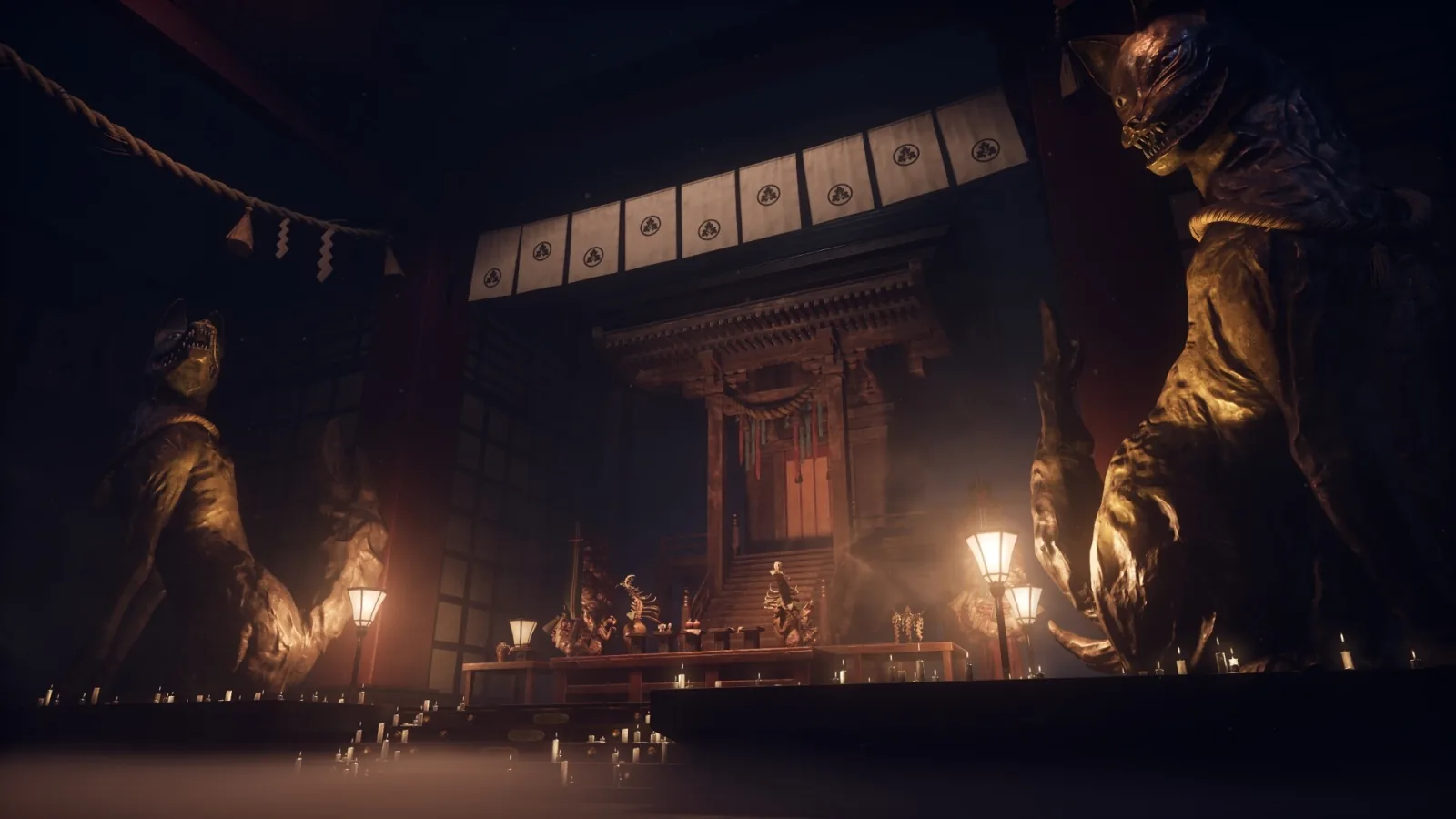
The notebook describes three layers that sit on top of each other: the older faith tied to the divine tree and the Sacred Sword, the Inari-sama worship that replaced it, and the village customs that survive in the present. The shrine is where all three are visible at once.
The endings use that stack. The sword, the Jizo statues and the purification are not separate folklore; they are the older layer pushing back through the newer one.
What the village believes
Ebisugaoka’s faith is a stack, not a single religion. The older layer is the divine tree and the Sacred Sword; the newer layer is Inari-sama, whose statues and hokora are everywhere in the present village. The kishu custom — retiring old tools at the shrine — sits between them as everyday practice.
That stack explains why the endings can use the same objects differently. The sword is a weapon in one route and a ritual object in another; the shrine is both a place of worship and a locked building.
What the village remembers
Sennensugi Shrine, the divine tree, the kishu custom and the name Ebisugaoka are the details the village still repeats. The lore entries treat them as ordinary local history, which is what makes the older story underneath them feel buried rather than announced.
If a place name in the walkthrough sounds unexplained, the matching lore entry is usually the shortest answer.
Ebisugaoka’s own stories
Chizuruya General StoreLore entry
It might have started as a general store, but we've come to call it the "candy store" because half of what it sells is just snacks and toys.
It's where all the kids hang out. My friends and I also meet up here, though we usually just sit outside and chat.
Shu and I decided that this place was the Space Army HQ when we played Space Wars.
When it wasn't just us playing, we would gather here to have mission briefings while eating candy.
Celluloid DollLore entry
It looks like a doll that I had when I was young. I don't have mine anymore, but there was a time when it felt like a friend to me.
In my opinion, a doll is a toy for girls. Because of this, I always felt like my doll was telling me that I should act more like a girl when I was playing with it...
One day, I was told by a girl that I couldn't play house with the other girls because I also hung out with the boys.
From that day on, I didn't want to play with the girls anymore. And so, I threw the doll away...
I knew it. This doll looks exactly like the one that I thought I had gotten rid of that day. I'm sure it hates me for throwing it away and abandoning it. When all of this is over, I'll ask my mom for a way to put it to rest...
FogTownLore entry
I live in the small, rural town of Ebisugaoka.
Before the war, the town was lively due to an influx of people coming for the coal mines and dam construction going on in the northern mountains.
After the dam construction finished and the coal mine closed down, it just became a sad little town.
The grand iron bridge that connects the town to the nearby city is the only reminder of this sorry town's former glory.
It's said that the kanji for "Ebisu" in "Ebisugaoka" holds the meaning of a person who has migrated from far away.
The most fanciful theory for the origin of this town is that it was a once a hidden village for Taira clan soldiers who lost the Genpei War.
In the town's old customs, there are a few rules that seem like part of a secret village's code—including things like not owning dogs or washing things in the river—but whether or not it's the truth remains a mystery.
According to another legend, once upon a time, a water dragon that resided here spewed poison so people would not approach.
Then, Inari-sama subdued the dragon and made the land hospitable again.
This area also has a surprising number of onsen. There is research suggesting that the tale of the water dragon could in fact be referring to an incident where onsen water containing noxious gas spouted out the ground like a geyser. I feel this theory is the most likely.
From the findings of a recent town hall investigation, it was observed that the mountains to the north and south of Ebisugaoka have a very brittle surface.
The town hall declared that a landslide could occur at any given time, but the residents argued back, saying that in the last several hundred years, there has been no record of such a disaster.
Sakuko says that the divine protection of Inari-sama is actually what's protecting Ebisugaoka.
I also remember her telling me with a straight face that when the residents no longer believe in Inari-sama, Ebisugaoka will return once again to an uninhabitable land.
Forgotten ShrineLore entry
I heard once that there was a shrine in shambles near Shu's house, but I never knew it was here.
Shu told me back then that there's treasure at the roots of the divine tree or something...
Sakuko once told me that this place is where the real Sennensugi Shrine is.
Sakuko's dream is to restore this shrine to its former glory.
But would such a thing even be possible? I can't really imagine the town's elderly residents climbing all the way up here...
People here used to worship the thousand-year cedar. Now, they pray to the Inari statues.
I'm starting to think that rather than some revered god, maybe we humans hold more power because we choose which god to worship...
Inari-samaLore entry
Ebisugaoka is mostly composed of Inari-sama's believers. There are statues of Inari-sama all over town. My elderly neighbors treat them with great respect and worship them. Inari-sama, also referred to as Oinari-sama, is a goddess that puts old, unusable tools to rest. They are known for their offerings preference of abura-age tofu pierced through with an old needle. It seems like other towns don't have these customs, though. I'm guessing they might be something special only we do for Inari-sama here in Ebisugaoka.
Inari-sama's statues act as memorials for old or broken tools.
It's okay to take these tools for your own as long as you have a use for them.
This is called "kishu," and it's an action that's considered virtuous.
It's a teaching of Inari-sama to make the most out of tools in any way.
The Inari-sama of Ebisugaoka has been the guardian deity that has protected this town since the old days, but they can be capricious at times.
Sometimes, they'll turn into a fox and steal chickens and dried persimmons; other times, they'll play tricks on children who don't listen to their parents.
I also heard that when they fall in love with a woman they find desirable at first sight, they spirit her away to be their bride.
Generally speaking, "Inari-sama" refers to the goddess of agriculture, Ukanomitama. The fox was the goddess's messenger, but over time their worship became intertwined. Nowadays, if anyone mentions Inari-sama, they'll think of the fox as well. Sakuko says that this is the just the fox taking the goddess of agriculture's position for itself. She also says that the goddess and the fox are having a supernatural fight on top of the Inari statues. That wild imagination of hers never fails to make me laugh.
Memories of Getting LostLore entry
There was this one time where I played hide-and-seek with a bunch of my friends when I was young. I got so excited and ran far away because I didn't want anyone to find me, and eventually got lost around here.
I was sobbing and hollering and walked the wrong way for hours—actually, I was told later that it was the exact opposite direction of my house.
Even a town as small as this felt huge for me as a kid. I realized that I knew nothing about the town. Even these fields seemed to spread out endlessly into the horizon.
I walk this path every time I go to Rinko's, but to be honest, to this day I'm still scared that I might get lost.
I mean, I've been told that I should probably just ask an adult for directions if I get lost... But then, I remember that one time when I walked on the footpath of the rice fields for fun and got smacked by an old farmer all of a sudden. The trauma from that experience made me scared of adults. Back then, and even to this day.
Ebisugaoka Middle SchoolLore entry
This is the middle school that I attended. It was built when the town was financially well-off during the dam construction, so the beautiful facilities are at odds with the rest of the dull buildings in town.
I think I met Rinko during my first year here. I remember her surprise when she heard that I called Shu "partner."
Ebisugaoka used to be a lively town with an ample labor force for construction and coal mining when this school was built. The town was always bustling, and the school was full of students.
The students at that time studied how to further improve the town as adults. The students of our time now study so that we can leave to go to a bigger town when we're adults.
A world that's not a playground like elementary school, but not as mature as high school. Middle school to me was like the stage between a tadpole and a frog—I guess you could say it's a period of grotesque transformations.
Up until elementary school, Shu and I would have water fights and we wouldn't mind if our underwear showed. Once we entered middle school, though, while we might not have paid any mind to things like that, others around us did. It just felt like our world changed in a snap.
Boys and girls used to think of one another as mortal enemies, always bickering and fighting each other. But now...
It suddenly turned into such a weird dynamic where we have to treat each other in a completely different way.
It's fine for people who want to do that because the people around them are doing the same.
But for someone like me, who really couldn't care less about what people think, that's not the case...
Origami of GrievancesLore entry
There's a custom that's said to get rid of your worries like magic. You write grievances that you can't tell anyone on a piece of paper, fold it into an origami fox, and then throw it somewhere that no one else will find it.
If you happen to come across someone else's origami of grievances, you can put it to rest by reading it.
No matter what's written on it, you have to keep the information to yourself and not tell a single soul.
It's a tradition that's been in this town for ages, but it was particularly popular with middle schoolers.
Some kids would indirectly bully others by writing gossip about the people they hated and making sure to put it in a place they would see it.
I personally don't like to write bad things about people—or read them for that matter.
They say that you can put those complaints to rest by reading them, so I make the effort to read them out. But to be honest, I'd rather not pick them up when I see them.
I remember Rinko folding up origami all the time. I don't know what was on them, but I saw her writing down things during class and folding paper into foxes on multiple occasions.
She keeps writing her complaints on pieces of paper, but instead of burning them, she just decides to throw them in the void and let them accumulate.
I think that maybe one day, all of those grievances will pile up and suffocate her...
Sakuko says that if you put something as abstract as your feelings into words, even as a complaint, that will be enough to put your heart to rest.
When you're feeling down, it's like having clothes scattered around in your room. And when you write it into words, it's like you're folding them into nice and neat piles.
It's basically like organizing your feelings and folding them away to put them to rest with Inari-sama.
This is apparently the real magic behind the origami of grievances.
Park of MemoriesLore entry
I think this is the park I used to play at a lot when I was little.
I feel like all my memories of fun times and hard times took place here.
Playing house with girls, and playing dodgeball with boys...
But kids will tell you that it's weird for girls to play with boys.
They told me they wouldn't let me play because I hung out with the boys.
I remember that moment of rejection and denial crystal clear in my head.
Why do Showa kids try so hard to keep boys and girls so clearly separated?
Is it truly such an awful thing to be a part of both groups?
Evil-Warding LanternLore entry
A type of revolving lantern that has a long history in Ebisugaoka. The picture silhouette rotates inside the lantern due to the air current that the candle makes. Normally, revolving lanterns are for entertainment, but the ones in Ebisugaoka were specifically used to ward off evil. In Ebisugaoka, there is a custom where women in unlucky ages hang it on their front door during Obon.
Sennensugi ShrineLore entry
A lonely little shrine situated on the outskirts of town. The name Sennensugi Shrine sure sounds fancy, but that's all that it has going for it. Even though Ebisugaoka is full of elderly believers, this shrine rarely gets any visitors. They instead go to what's closest to them—and that's an Inari statue.
Sakuko's family serves the shrine, including fulfilling the role of head priest. Sakuko is quite proud of this fact, but I don't know if the same could be said about her parents.
I remember what Sakuko once said.
Sennensugi Shrine didn't use to be the small shrine that we know—the real shrine was situated on the mountain, and it was much more impressive than it is now.
Long ago, there was an actual thousand-year cedar that was worshiped as a divine vessel. Unfortunately, it was struck by lightning and burned to ash. Upon losing its divine vessel, the shrine was abandoned and became the small shrine it is present day.
Sakuko says that the custom of putting old tools to rest is called the Tsukumogami faith.
During the course of history, it somehow fused with the Inari faith, making it a special religious view of Ebisugaoka.
The only shrine in town, Sennensugi Shrine was, as its name suggests, worshipping a thousand-year cedar as its divine tree. After living to see a thousand years, it was praised as divine.
And then, once the divine tree turned to ash, it was time to worship the next oldest thing. Sakuko reckons that it just so happened to be the moss-covered Inari statue.
The believers' world and the gods' realm are not impervious to change. No matter how revered a god may be, their believers can choose to worship another god, or the religion could prove impossible to preserve in its original form. The Tsukumogami faith, where one would worship old things, shifted over to Inari faith once the object of worship changed to the moss-covered Inari statues.
I'm sure that the mix of the Inari faith and Tsukumogami faith is only one of many cases. And once a hundred years pass... who knows? The tanuki statues of Shigaraki could be the next object of worship.
Space WarsLore entry
This is a game that Shu and I played together when we were kids.
Basically, aliens, known as the Galactic Imperium, would arrive in UFOs in droves, and we would fight them to protect the town.
Playmates would come and go (we called them new recruits and fallen ones, respectively), and in the end, Shu and I were the only ones left standing to combat the Galactic Imperium.
Space Wars wasn't just about fighting evil with laser guns, though. We'd pretend to analyze the enemy by drawing alien sketches. During P.E., we'd say that the class was a training camp for the Space Army. I think we played with dolls too... Right, I think that's when we were training in first aid in order to assist the injured.
Not to brag, but we've taken down the enemy's mothership, the giant UFO, on many occasions.
However, each time that happened, the Galactic Imperium would deploy more and more troops from their home planet.
As we grew older, we were able to have a better understanding of heroes by watching television, and I think we came up with some elaborate backstories for the enemy leaders.
By this time, it was a world that only Shu and I knew.
There've been times when I wished from the bottom of my heart that Space Wars would continue forever.
But as we grew older, the Galactic Imperium stopped sending in new forces.
We're still proud members of the Space Army and will always be on standby to defend the Earth. We still call each other "partner" like the old times.
Even if our classmates laugh and say that it's lame, our Space Wars have yet to come to an end...
The Great Space InvasionLore entry
Shu watched this movie when he was young and came up with the Space Wars game we used to play. I watched it back then too because my dad dragged me to see it. I don't have any memories of that time, but according to my dad, it scared me so much that I couldn't stop crying for days.
Since this was the inspiration of Space Wars, I was thinking that it'd be an exciting story. Apparently, that only applies to the last scene, with the rest of it just being a sci-fi horror movie.
Shu didn't like that when he was younger, and so it was his dream to fight back with his very own Space Army. That's one of the things I like about Shu. He doesn't let reality hold him back.
The sword chain in one paragraph
The lore’s older layer is the Sacred Sword: a divine tree, five Jizo statues and five old offerings. In play, that becomes the New Game+ chain — make the five offerings, take the sword, finish Crimson Water and decide at the basin whether to purify it. The shrine’s newer Inari-sama worship sits on top of that older story, which is why both appear in the same locations.
How the lore frames the endings
The endings ask what the shrine is protecting and who is allowed to decide. The lore gives both sides: the village’s need for a guardian and the older claim that the sword represents. The story carries that into the plot; the endings carry it into the conditions.
Read the Inari-sama and Sacred Sword entries before the endings if the final choice feels like it comes out of nowhere.
Where the lore leads
The Sacred Sword chain is the lore made playable: five Jizo statues, five old offerings and a choice about purification.
Sacred Sword → · Story explained → · Characters →
Lore questions
What is Inari-sama in Silent Hill f?
The village’s guardian deity, worshipped at Sennensugi Shrine. The notebook explains that Inari-sama replaced an older faith tied to the Sacred Sword and the divine tree.
What is the Sacred Sword’s legend?
A sword buried under a barrier of five Jizo statues, tied to the Taira clan and the village’s hidden history. The lore entries are the context for the sword chain and its endings.
Do I need the lore to finish the game?
No, but it explains why the shrine, the Jizo statues and the purification matter. The Sacred Sword and endings are easier to follow after the Inari-sama and divine tree entries.