Abbey · Devotees
Chants of Sennaar church puzzle
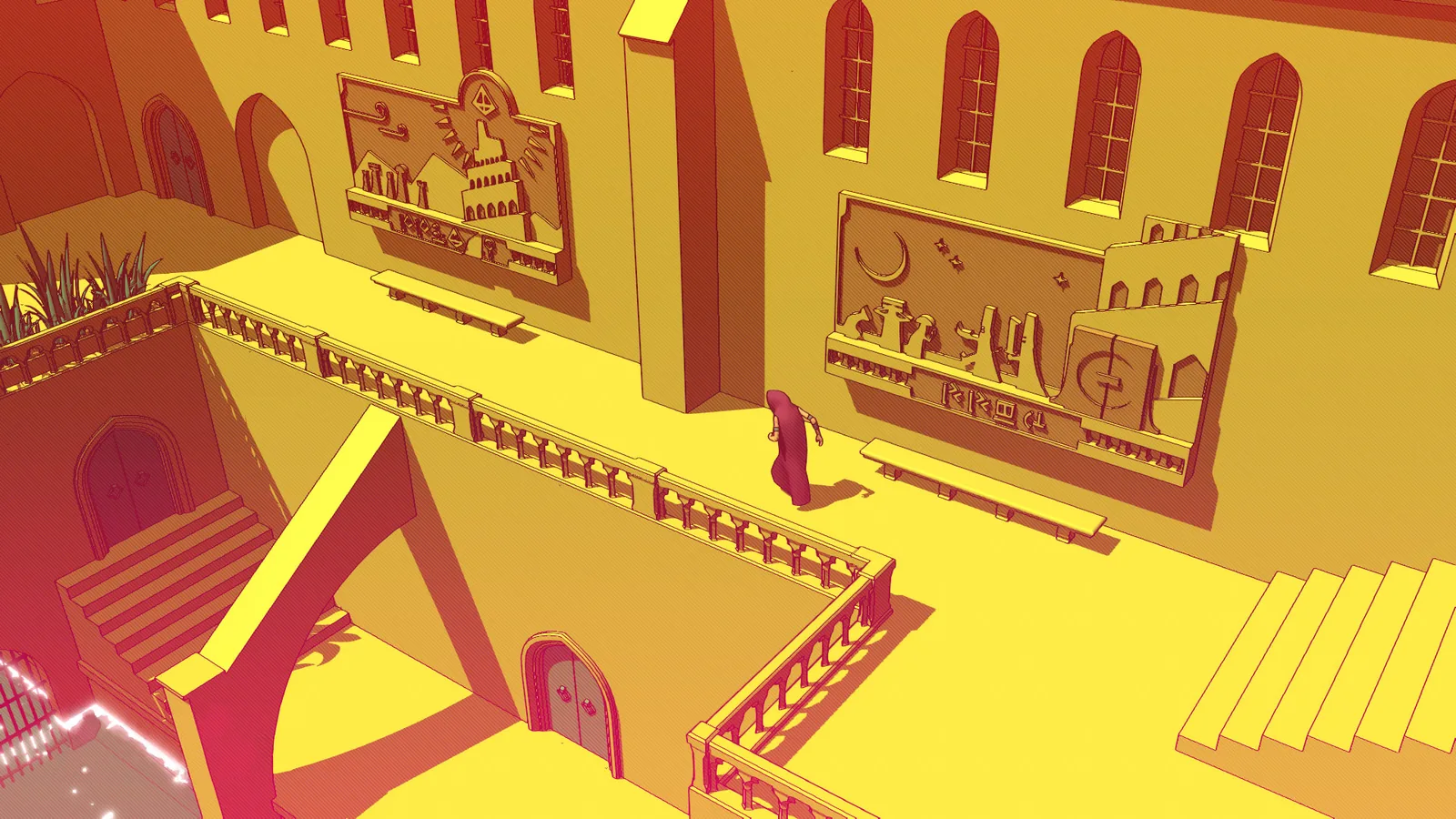
The church has a door puzzle on the forecourt and a wheel puzzle inside. The door is a hierarchy; the wheels spell the four sentences painted in the chapel. Use the Lens in the chapel so the wheel glyphs become readable.
Why the church has two puzzles
A hierarchy outside, four sentences inside
The forecourt panels ask who stands above whom. The chapel wheels ask what each person is looking at. They use the same Devotee words but test different things.
The four names on the outside are God, Warrior, Devotee and Man. The Abbey’s card table teaches that order before you reach the church, and the beggar’s coin gets him away from the door so you can read the panels. The panels are vertical: the top slot is the highest rank, the bottom slot is Man.
Inside, the four painted lines are not a hierarchy. Each one is a small scene with an actor, a verb and a target. The twelve wheels repeat those scenes in rows. Put the Lens in the chapel device and the wheel faces become readable; without it you are turning blank rings.
Part 1
The four panels outside the church
The panels are a vertical hierarchy, not a word puzzle. The card table in the Abbey teaches the same order.
 GodGOD
 WarriorWARRIOR
 DevoteeDEVOTEE
 ManMAN/HUMAN
- Give the beggar the coin from the cart puzzle, then look at the four panels to the left of the door.
- Look at the four sliding panels to the left of the door. Each one carries one Devotee glyph.
- Set God at the top, Warrior second, Devotee third and Man at the bottom.
- The door opens when the last panel snaps into place. You do not need the Lens for this part.
Part 2
The twelve wheels inside the church
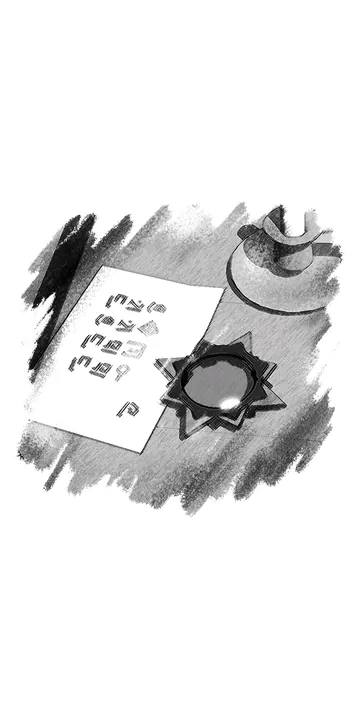
The chapel has four lines painted on the walls. Each row of three wheels spells one of them. Put the Lens in the chapel device first, or the wheels look blank.
MAN / HUMAN SEE / LOOKDEVOTEE
The Man looks at the Devotee.
DEVOTEESEE / LOOKGODThe Devotee looks at God.
 PREACHER
 TALKMAN / HUMAN
The Preacher talks to the Man.
GODSEE / LOOK INSTRUMENT
God looks at the Instrument.
Pick up the Lens in the Abbey workshop and bring it to the church.
Put the Lens in the device in the middle of the four chapel panels.
Turn the top row to MAN, SEE, DEVOTEE.
Turn the next row to DEVOTEE, SEE, GOD; the third to PREACHER, TALK, MAN; the last to GOD, SEE, INSTRUMENT.
What happens after the wheels
The church door opens and the Devotee page in the journal should be close to full. The Preacher’s note in the workshop points to the cemetery, where the same four sentences are used again as a chain of sight. The Lens is not needed there, and the cemetery has no wheel device.
Common mistakes
- Panel orderReading the four plaques left to right instead of top to bottom puts Man above God.
- Blank wheelsThe Lens must be inserted in the chapel device; turning the wheels without it does not reveal the glyphs.
- Wheel rowsEach row is one line, not one sentence split across the whole wall. Start each row at its left wheel.
- CemeteryDo not bring the Lens to the cemetery. The four figures are turned by hand.
Questions players ask
What is the order of the four church panels?
Top to bottom: God, Warrior, Devotee, Man. The gate uses the same hierarchy the Devotees use in the Abbey.
How many wheels are inside the church?
Twelve: four rows of three. Each row spells one of the four sentences painted in the chapel.
Do I need the Lens for the church wheels?
Yes. Put the Lens in the chapel device so the wheel glyphs become readable. The Lens is found in the Abbey workshop.
Why do the two church answers look different?
The forecourt panels are a social hierarchy. The interior wheels are four sentences. Both use Devotee words, but they are separate puzzles.